
Welcome to BrainStim Centers!
Welcome to BrainStim Centers!
We are so excited to be a part of your journey to better health and wellness.
BrainStim Centers is dedicated to treating a wide array of mental and neurological illnesses through Transcranial Magnetic Stimulation (TMS).
We have clinics located throughout Los Angeles County, in Valencia, Calabasas, Lancaster, and Van Nuys.
What is TMS?
TMS stands for Transcranial Magnetic Stimulation. It is a non-invasive treatment which utilizes electro-magnetic coils to stimulate neurons in the brain. When neurons fire, they form connections with each other, and the more they connect, the stronger those connections become. By stimulating specific parts of the brain, we help the brain get better at communicating with itself, which increases focus, improves mood, and decreases headaches and brain fog.
What isn’t TMS?
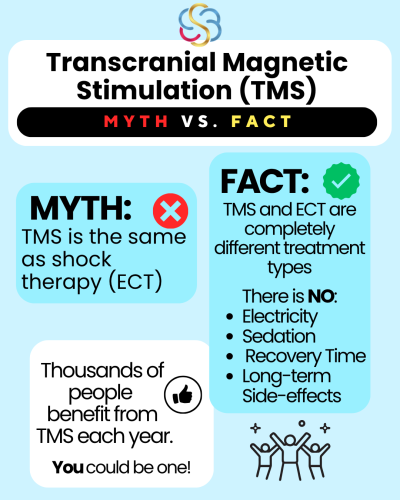
TMS is not surgery. TMS does not use any needles, scalpels, or sedation.
TMS is not pharmaceuticals. TMS does not use chemicals to alter the brain, only magnetic stimulation.
TMS is not “shock therapy”. TMS does not use electric shocks or currents to alter the brain.
- Pre-Diagnostics
- MRI
- EEG
- Questionnaires
- Mapping on NexStim
- Typical Treatment on NexStim
- Preparation
- Registration
- Treatment and Placements for MDD Patients
- Timelines
- Daily MDD Patients
- Daily TBI Patients
- Accelerated TBI Patients
- Contacts
- How to Maximize TMS Benefits
- FAQs
Use Ctrl+F to navigate between sections
Pre-Diagnostics
MRI
At BrainStim Centers, we use a specialized MRI to capture detailed images of your brain that help guide your personalized care. MRIs are non-invasive, pain-free, and are typically completed in about 15 minutes.
About your MRI
- If you received a link to this website, you have already been scheduled for your MRI appointment,
- The time, date and address of your appointment can be viewed on your official BrainStim Schedule which has been emailed to you.
- This scan provides important imaging that helps guide your care and treatment planning
- If you need to reschedule your MRI, please contact Roxanna at (747)247-1700
Before your Appointment
- Please arrive 15 minutes early for check-in and any necessary paperwork
- This helps ensure a smooth, stress-free experience
During the MRI
- The scan takes approximately 15 minutes
- You will lie on a table that gently moves into the MRI machine
- Only your upper body (up to your chest) will be inside the machine
- The machine can be loud, and earplugs will be provided
- We recommend keeping the earplugs in for the entire scan
- No needles or contrast are required
If you have concerns
- If you experience claustrophobia, let the technician know
- A mirror can be provided so you can see outside the machine
- If you plan to take medication to help you relax:
- Please notify us in advance
This may affect scheduling of other diagnostics (such as EEG) - You will need someone to drive you to and from your appointment.
- Please notify us in advance
After your MRI
- Please wait to receive your burned CD before leaving.
- You will need to bring this CD to your BrainStim appointment.
EEG
At BrainStim Centers, we use an electroencephalogram (EEG) to observe your brain wave frequencies and isolate the exact amplitude of your peak Alpha frequency. EEGs are non-invasive, pain free, and are usually done in about 30 minutes.
Your technician will explain the setup process, which includes:
- Placing a lead* on your chest for an EKG recording.
- Fitting a cap on your head (similar to a swim cap, but looser).
- Applying a small amount of conducting gel under the cap to ensure accurate readings.
-The conducting gel that we use is water soluble, so while your head/hair may feel wet after the EEG, it will come out with water when you shower next.
There are some things that you should and should not do to prepare for your EEG:
DO:
- Get a good night’s sleep the night before
- Take your medications as usual.
- Try to have a relaxing morning before your EEG.
- Drink water/eat as normal.
- Remove any adhesive that was present on your head for extensions/wigs.
DON’T:
- Drink anything with caffeine in it before your EEG.
- Put gel/dry shampoo/hair spray in your hair.
- Take any medications that affect cognition (unless prescribed).
- Consume alcohol within 12 hours of your EEG.
- Use any cannabis products within 12 hours of your EEG.
Once set up, your technician will ask you to close your eyes and relax in a dimly lit room for 10 minutes while we record your brain activity. Your technician will remain in the room and may gently remind you to relax if they notice any muscle tension.
When your scan is done, your technician will remove the cap from your head and the EKG lead from your chest and give you a paper towel to wipe off some of the conducting gel. Feel free to use our restrooms if you would like to organize your hair/clean off the gel more thoroughly.
Assessments
All patients take assessments before and after the of their treatment to assess their mental and neurological health symptoms. Which assessments you are assigned depend on your medical history.
All patients take the PHQ9 and GAD7 assessments.
MDD patients with a history of PTSD take the PCL5.
MDD patients with a history of OCD take the YBOCS.
TBI patients take the RPQ, CHEMS, and PCL5.
Patients receiving daily treatments will repeat assessments every Friday throughout the course of their treatment.
The video above is not from an affiliated MRI center, but it is a good example of what you would experience at your pre-treatment MRI.
Find your MRI center above.
EEG and Treatment Centers
Mapping on NexStim
On your first day of treatment, before your first treatment, your techs will perform a Brain Mapping. The Brain Mapping is used to find your Motor Threshold (MT) which determines your Goal Intensity (GI), it essentially determines the therapeutic dose of stimulation you need for effective TMS!
What happens during a brain mapping?
How to Prepare
- Wear comfortable clothing – No need to dress up on our account! Make sure you arrive in clothes you will be comfortable in for at least 45 minutes.
- No metal or other accessories in hair, this include bobby pins, barettes, wigs, and weaves. These items interfere with our ability to perform TMS because they are physical barriers between the stimulation coil and the scalp.
- If you typically wear your hair in protective styles, like braids or locs, we recommend trying to time your hair appointments around your mappings so that your hair can be worn loose when the mapping is performed.
- Bring your
- Photo ID
- Insurance information
- Current medication list.
What to expect
Your psychiatric nurse practitioner, Jackie, will be present either in person or via Zoom. Due to clinician availability, mappings will always happen between 2 pm and 3 pm.
Step by Step
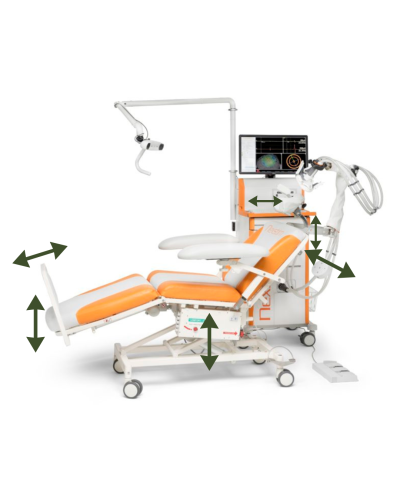
- Once in the room the chair is adjusted for comfort, everything about the chair is adjustable from the angle of the legs and back to the height and angle of the head rest.
- During the mapping patients are required to sit upright, but during treatment the chair can be reclined for better comfort.
- Patients are highly encouraged to communicate with their tech around their comfort level. Remember, you will be in the chair for 30+ minutes, and we want you to feel comfortable!
- EMG’s are attached to the hand in three places in order to detect twitches so small that they may not be seen, or even felt!
- These EMG’s stick with a medical grade adhesive so your technician will prep your hand with a small alcohol pad.
- Once the EMG is prepared and you are registered to the TMS machine, your technician will stimulate the hand knob* on the Motor Cortex to cause a thumb twitch.
- Your technician will stimulate multiple parts of the hand knob with single pulses, you may feel pressure from the coil on the top and side of your head, above your left ear.
- What you’ll feel:
- A light tapping sensation on the side of the head.
- A slight twitch in the eye.
- A thumb, or another finger twitch.
- Calculating the Goal Intensity:
- Once the “hotspot”** is located, your technician will save it to the machine software.
- Your tech will then stimulate only the hotspot with single pulses, each one spread 3-5 seconds apart.
- The intensity of each pulse will move up or down, it may cause large twitches, or no twitch at all. The machine uses the data from this process to determine your Motor threshold.
Goal Intensity and Titration
Your brain mapping determines your MT is used to calculate your Goal Intensity (GI). The GI depends on the treatment placement and protocol.
Patients receiving treatment for MDD and mood disorders typically receive 3 treatments: rTMS, iTBS, and cTBS.
The GIs for rTMS and iTBS are both 120% of the MT, and the GI for cTBS is 100%.
On the first day of treatment, you will not be stimulated at your GI. Your tech will stimulate you at 80% of your MT on your first treatment and will increase the treatment intensity in small increments over the first 5-7 treatments until you reach GI. This is to minize discomfort and side effects by allowing your brain and body time to adjust to TMS stimulation.
Note on MT: Motor threshold is not an indication of brain health, and is only used to determine the therapeutic intensity for TMS. The range for “normal” is extremely large.


*A spot on the Motor cortex which sends signals to the hand to move, we stimulate it to cause a thumb twitch.
Typical Treatment on NexStim
To learn more about what to expect during each of your treatments, read a description of a single appointment below.
Preparation
- At the beginning of every treatment, the tech will adjust the chair to your comfort.
- Always remember that the tech is happy to do so; it is not much work for the tech, and it is very important to us that you are sitting comfortably during your treatments.
- During your treatments you may also have the option to play music or a video if your treatment room is equipped with a tv.
- The head tracker applied on the right cheek of the patient near the nose.
- The head tracker is applied with a sticker. The tech may prepare the skin with an alcohol pad to remove any oil, sweat, or makeup to help the sticker stay secure through the whole treatment.
- The tech will adjust the camera so that the head tracker is in view.
Registration
Once you are comfortable and set up in the chair your tech will perform your “registration”
We use neuro-navigated TMS, which means we use biomarkers from your brain to precisely and accurately place each treatment. To know that we are treating the exact right spot on your brain, we must tell the computer where you are in real space, so it can line you up with the model of your brain on the computer. We do this by ”registering” you to the machine at the beginning of every treatment.
Your tech will simply touch the digipen (pictured right) to your left ear, your nasion (between your eyes) and then your right ear. Sometimes, your tech may have to repeat this process more than once to ensure accuracy. Following the three points, your tech will then mark 9 additional points along your scalp.

Treatment and Placements for MDD Patients
Insurance patients are typically prescribed 3 daily treatments.
- The “19”-minute rTMS (repetitive TMS)
- 19 in quotes because it takes anywhere between 17 and 21 minutes depending on your alpha-peak frequency
- 3-minute iTBS (intermittent theta bursts)
- 40-second cTBS (continuous theta bursts)
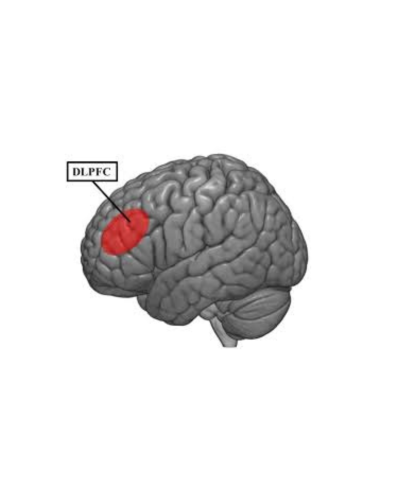
Left DLPFC: rTMS and iTBS
The rTMS and iTBS treatments target the same place in the brain, the left dorsolateral prefrontal cortex (left DLPFC). This is the left side of the head, near the front and top of the head.
The left DLPFC is important for social-emotional processing; it is stimulated to treat depression because depression is associated with reduced activity in this part of the brain.
- The 19-minute rTMS is the first treatment administered every session, and the only one required by insurance. However, patients have the best outcomes when they complete all 3 treatments, and there is no difference in cost.
- It feels like a few seconds of rapid tapping followed by 11 second breaks.
- The 3-minute iTBS follows, and it is placed in the same spot as the rTMS.
- Although the treatment intensity is the same between the rTMS and the iTBS, patients often say it feels more intense, fortunately it is very short! It is 10 theta bursts (3 pulses put out at almost the same time), with 8 seconds between each train.
Right DLPFC: cTBS
The cTBS treatment targets the right DLPFC. This is the right side of the head, near the front and top of the head.
The right DLPFC is similarly important for social-emotional processing; it is stimulated to treat anxiety because anxiety is associated with over activity in this part of the brain. Continuous stimulation is used to “tire out” the neurons in this part of the brain and relieve anxiety.
- The 40-second cTBS is the final treatment each day, before starting your tech may have to adjust the chair and camera position.
- To keep the head tracker and camera in view, the chair typically needs to be reclined during this treatment.
- The cTBS treatment consists of continuous theta bursts for 40 seconds.
Patients experience cTBS as similarly intense to the iTBS.
Treatment Timelines
Pre-Treatment
- MRI
- EEG
- Assessments
Daily Treatments
Treatments 1-30 happen every day (Monday-Friday) at your scheduled time.
You are responsible to notify the team of any days in which you need to reschedule your treatment as soon as you know of them. Treatments can be rescheduled to another time of day as needed depending on staff and your availability. If you are unavailable for a day of treatment, this treatment will simply be added on to the end of your scheduled period
- Treatment 1: Mapping & First treatment.
- Treatments 1-5: Titration.
Midpoint
Between treatments 15 and 20 you are required to complete a midpoint EEG and a remapping.
This is to update your treatment protocol so we can keep providing treatments that are accurately customized to your MT and alpha peak frequency.
Tapering
For treatments 31-36 we “taper”, meaning we increase the amount of time between each of your treatments. This helps reinforce your benefits from treatment and helps avoid any dip after finishing treatment.
Tapering typically happens over the 2-3 weeks
Post-Treatment
- EEG
- Assessments
Pre-Treatment
- MRI
- EEG
- Assessments
Daily Treatments
Treatments 1-30 happen every day (Monday-Friday) at your scheduled time.
You are responsible to notify the team of any days in which you need to reschedule your treatment as soon as you know of them. Treatments can be rescheduled to another time of day as needed depending on staff and your availability. If you are unavailable for a day of treatment, this treatment will simply be added on to the end of your scheduled period
- Treatment 1: Mapping & First treatment.
- Treatments 1-5: Titration.
Midpoint
Between treatments 13 and 18 you are required to complete a midpoint EEG and a remapping.
This is to update your treatment protocol so we can keep providing treatments that are accurately customized to your MT and alpha peak frequency.
Post-Treatment
- MRI
- EEG
- Assessments
Pre-Treatment
- MRI
- EEG
- Assessments
Treatment Week
You will complete 10 treatments a day Monday-Friday during the week of your treatment, for a total of 50 treatments.
Each treatment is 15 minutes, and you will have about 40-45 minutes of break between treatment.
On the first day of treatment before your first treatment your techs will complete a brain mapping on you. Titration takes place for the first 5-7 treatments.
- Treatment 1: Mapping & First treatment.
- Treatments 1-5: Titration.
Lunch
Lunch is on us every day during treatment. You may order anything you want through Doordash for under $25.
When you are ready to order, you can ask your technician for the iPad and explore what is around locally.
Remember to think ahead, don’t wait until you are starving, because food delivery can take anywhere between 20 and 60 minutes.
Post-Treatment
- MRI
- EEG
- Assessments
Side Effects
Fortunately, with proper safety precautions, like ear protection, there are no long term side effects of TMS, making it a very safe treatment.
However, as you begin treatment you may experience:
- Mild headaches
- Fatigue
- Scalp sensitivity/soreness
And while receiving treatment you may experience:
- Facial pain
- Facial twitching
Although it is extremely rare, if you begin to experience any seizure-like activity please contact us immediately.
**The “hotspot” is the spot on the hand knob that most consistently produces a thumb twitch.
Who to Contact and When
If you need to reschedule your EEG, MRI, or treatment, please contact Roxanna ASAP.
Roxanna
(747) 247-1700
Please contact the site of your treatment for matters of attendance and day to day scheduling.
How to Maximize TMS Benefits
TMS treats the physiological aspects of mental and neurological diseases, like depression and anxiety, but that does not automatically help with the social and behavioral symptoms. By treating the brain’s symptoms of your diagnosis, TMS can help get you to where you need to be to help yourself.
Here are a few ways to maximize the social, emotional, and behavioral symptoms of depression:
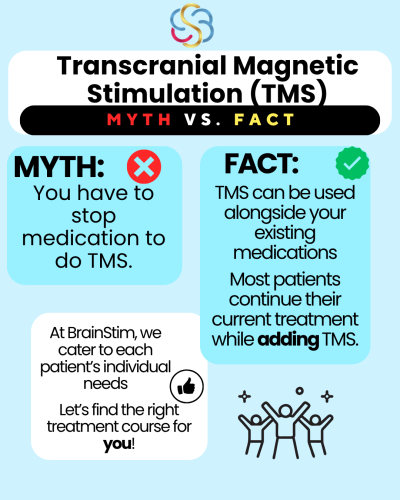
Do not change your medications during TMS treatment.
Unless it is absolutely medically necessary, please keep your medication regiment consistent through your whole course of treatment.
Reduce alcohol.
Alcohol reduces how responsive the brain is to TMS and alcohol withdrawal increases risk of seizure like activity from TMS.
Light exercise.
Exercise is essential to both physical and mental health, but of course it is hard to have the motivation when dealing with a mental or neurological disorder.
If it is not already part of your routine, adding even just 10-20 minutes of light exercise (like a walk or a stretch, whatever your body can handle) can significantly improve your overall cognitive function.
Increase time spent with loved ones.
It’s no big revelation that connection to others feels good.
There are many levels of connection, from being in the same room, to a passing conversation with a stranger, petting a dog or cat, or hugs and kisses. All types of interaction are shown to decrease pain, anxiety, and stress and increase calmness and happiness.
Oxytocin is the “love” hormone, it is the chemical released in your brain when you feel connected to someone else. The Oxytocin System in the brain helps support the Dopamine and Serotonin systems of your brain and it makes your brain more resistant to stress!
Stimulation through socialization can strengthen the Oxytocin System in the brain.
It may take some “practice” as oxytocin systems in the brain can be dysregulated by diseases like depression, but by exercising those systems you can help heal them.
Improve Sleep Hygiene.
Sleep is fundamental. Poor sleep causes all sorts of mental and physical dysregulation, and mental and physical dysregulation cause poor sleep. It can become a difficult cycle but try your best to help yourself break out of it.
Try following the 10-3-2-1 Rule for good sleep hygiene.
Attend Therapy.
As established, TMS prepares the brain and body for better healing, but there’s more work to be done through the choices you make.
TMS helps give you the energy and motivation to make positive change, but it is still up to you to make the right choices. Therapy is a great way to focus your time and energy to creating change within yourself and in your life so that you can remain happy and healthy.


FAQs
Does TMS treatment hurt?
TMS can cause discomfort and soreness in the direct location of stimulation; however, your technicians will work with you to minimize acute discomfort by slowly increasing treatment intensity, and by adjusting the coil angle to reduce facial twitching. There is also lidocaine onsite which can be applied topically to help with soreness from treatment.
How long does it take for TMS to work?
Every brain and individual is different, which means there is a wide range of “normal” responses to TMS. While it is common to feel lightly fatigued when first beginning treatment (like for the first 2 weeks for daily patients, or the first 2 days for accelerated), patients often begin to feel relief in the following days/weeks. However, it is also common for patients to improve closer to the end of their treatment, or even in the time directly following the end of their treatment (especially for accelerated protocols).
How long do TMS results last?
There’s no expiration date on the benefits of TMS, but many patients return for additional treatment when they notice sleep/energy disruptions, motivation fading, decreased mood, increased anxiety, concentration difficulty, or decreased enjoyment of life. Maintenance is a part of progress, and not an indication of failure. Many people benefit from periodic “booster” sessions or even repeat a full course month or years later. Each brain has its own timeline.
Can I sleep during treatment?
It is recommended that patients stay awake and relaxed during treatment. TMS treatment is developed to work on a brain that is awake and relaxed. Brain activity during sleep is different and may not be conducive to benefits from TMS. It is most commonly recommended that patients close their eyes during treatment and relax, but if you find it difficult to stay awake, you may also chat with your technician, look at your phone, or watch something on the television (if there is one in you treatment room).
Can I wear wireless ear buds during treatment?
No, patients are not permitted to wear wireless ear buds or hearing aids during treatment. Proximity between the magnetic stimulation and the technology may increase risk to you as a patient, or to the technology. Ear plugs are provided and required during every treatment to protect your ears.